
Architecture, Specification, Execution: A Paradigm for AI-Accelerated Development
Carve the path for AI to follow, don't walk it yourself

AI tools have been around for a minute now, and while “vibe coding” seemed fun for a moment, it’s becoming clear (at least to me) that it hasn’t quite lived up to the hype.
Want to get “something” created quickly? Sure, vibe away. But let’s be real - most of us build specific products with ever-changing requirements, and there comes a point where “vibing” gets you nowhere fast. Instead, what we need is a stable foundation that maintains velocity and cuts through the noise.
You might question if AI is living up to the hype. Honestly? I think it is - but not through vibe coding. I’ve spent enough time tinkering with these tools to know they’re powerful, but we engineers need a paradigm to actually harness that power and condense that week’s worth of work into a day (like we were promised).
In this post, I’m going to share a paradigm that’s been working for me. To be clear: I’m not advocating for any particular products - Copilot, Kiro, Cursor, they’re all amazing. What I’m offering is an approach that works regardless of which tools you choose, delivering the compounding returns vibe coding never reaches.
Here’s the core principle: carve the path for AI to follow, don’t walk it yourself.
Your job as the engineer is to set direction, establish constraints, and define success. AI’s job is to execute within those boundaries. Mix these roles and you’ll just muddy the waters.
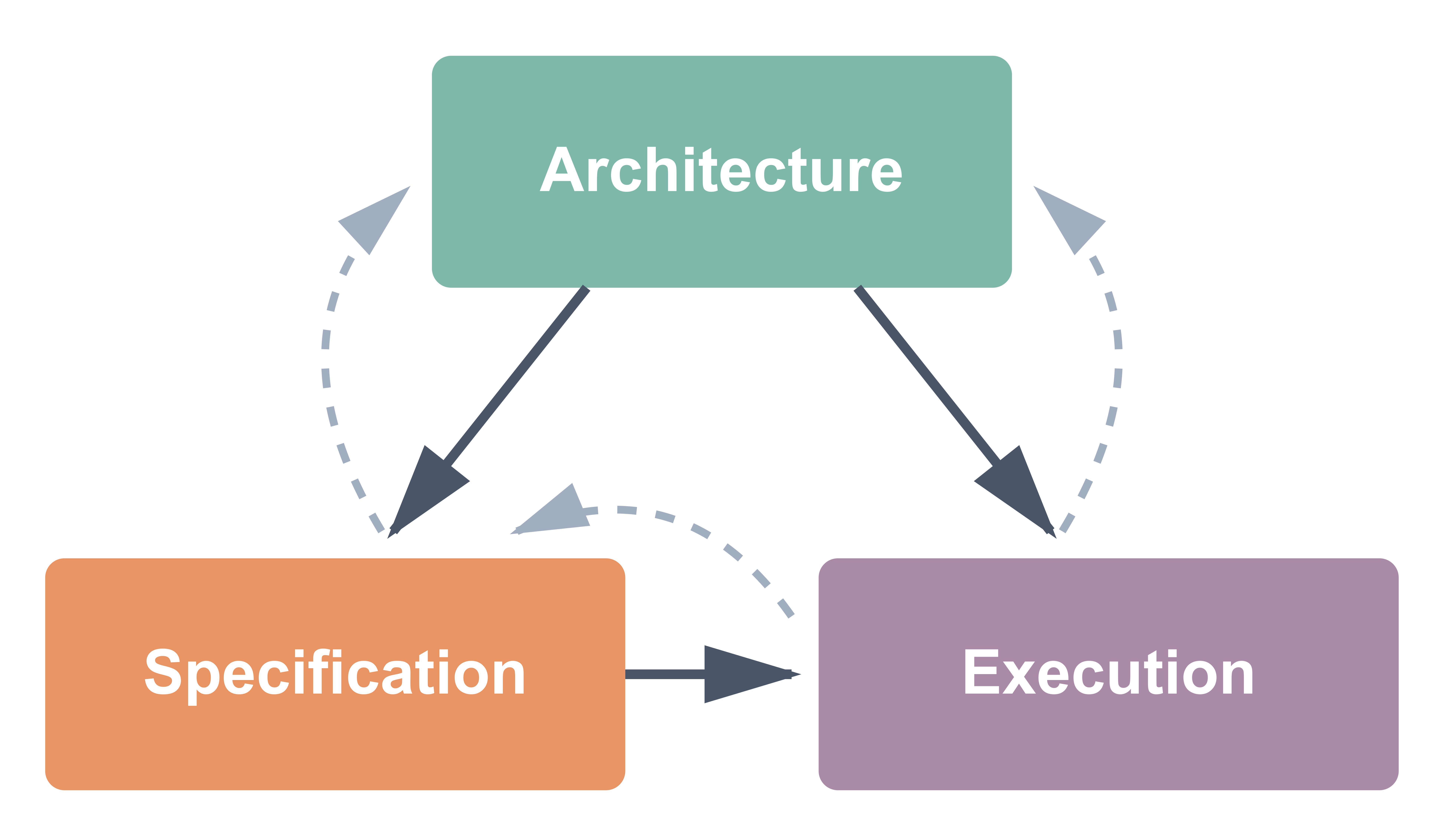
This paradigm builds on spec-driven development, and it consists of three pillars:
Architecture - Document the decisions that shape your system
Specification - Define the features within those constraints
Execution - Prompt and let it run
Here’s what makes this work: it’s a recursive system that feeds itself. Your execution prompts reference your specifications, which reference your architectural decisions. Each layer builds on the previous one. Architecture sets the container, specifications define what to build inside it, and Execution is where AI does the heavy lifting - all feeding back into a cycle that gets sharper each time.
The result? An optimal environment that maximizes code shipped to production.
Ok, let’s dig in.
Architecture: Document the decisions that shape your system
Before planning features or generating code, answer this: What are the foundational principles that define this project? We need guardrails - a series of governing ideas that create a well-defined container around everything we build. The key asset here is Architecture Decision Records (ADRs) - documented decisions about your technical approach that serve as this foundation.
What belongs here?
Tech stack choices, authentication approach, API design philosophy, state management patterns, testing strategy - every architectural decision that will guide future work. Think of this as your “source of truth” - the ultimate reference point for any decision made in this environment.
Example: “We’re using Zustand for state management because our app needs global state without the boilerplate of Redux, and Zustand’s simplicity aligns with our preference for minimal abstractions.”
Why does this matter?
AI needs context, and it needs the right context. AI has access to every pattern and approach imaginable. Every time you prompt it, it could consider countless solutions - that’s far too much. The goal is to narrow that window at the start, forcing AI to work within pre-defined channels.
Having architectural decisions on record makes this clear and binding. Once it has a constitution to follow, you prevent “drift”, where each AI-generated feature uses a different pattern.
How to create them?
Communicate.
Not just with AI chatbots, but with peers and stakeholders. Nail down requirements and limitations first. The more information you can distill, the better. Compare approaches, discuss trade-offs, and determine what makes sense for your situation.
As you progress, confirm your decisions, document the rationale, and keep it clear. Remember: these form the outer bounds of the context window for every prompt when generating code, so precision matters.
Store these documents at or near the root level of your workspace. You can revise them later, but take care when modifying existing decisions.
The key takeaway
Time invested here pays dividends during feature development. AI can’t make these calls, but you can. This is where engineers are most valuable - communication, judgment, trade-offs, absorbing business context.
Everything outside these boundaries is noise that pollutes AI’s contextual awareness and leads to suboptimal results.
Once you have the container in place, it’s time for the next phase: specifications.
Specification: Define the features within those constraints
This is where we detail what we’re actually building. Think of specs as feature-level plans that operate within the architectural boundaries you’ve set. This is Spec-Driven Development at its core, and it’s the meat of this paradigm (you’ll spend most of your development time here). Tools like GitHub’s Spec-Kit are perfect for this.
Here’s the critical relationship: ADRs set the rules, specs define the moves. Your architectural decisions have already narrowed AI’s solution space. Now, specs guide it toward the exact outcome you want. Without ADRs, AI might solve your problem five different ways across five features. With ADRs and specs working together, AI solves it consistently, following your established patterns every time.
What belongs here?
Anything relevant to your feature’s context: user stories, API contracts, UI/UX flows, edge cases, business logic, dependencies, success metrics - if it helps define what you’re building, include it.
Be as precise as possible. This might feel tedious at first, but remember: the goal isn’t instant code - it’s an environment that consistently generates code matching your intent. Every detail you provide here saves debugging time later.
Why does this matter?
Specs give AI a clear target within known boundaries. The recursive system works like this: AI reads your ADRs to understand how to build, then reads your specs to understand what to build. The tighter the connection between these two layers, the better your results.
This is how you prevent drift at the feature level. ADRs prevent architectural drift (every feature uses the same patterns), while specs prevent implementation drift (every feature solves problems the way you intended). Together, they create consistency that compounds.
How to create them?
Write specs as if you’re briefing another engineer who’s already read your ADRs. Reference specific architectural decisions when relevant - “Following our ADR on state management, this feature uses Zustand for global cart state.”
Be specific about the end goal. Don’t say “build a user profile page” - describe what data it displays, how it handles loading states, what happens when data is missing, how errors surface to users. Define validation rules, edge cases, and data shapes.
If you’re integrating with external services, make data contracts explicit. Design mockups, API documentation, and screenshots from similar features all help AI understand your intent.
Keep specs in version control alongside your code. Unlike ADRs (which rarely change), specs will evolve as requirements shift.
Focus on what to build, not how to build it. That’s AI’s job. Define the destination clearly, and let AI figure out the route within your architectural constraints.
The key takeaway
If Architecture is your foundation, specs are your blueprint. This is where you translate business needs into instructions AI can execute. The clearer your specs, the less time you spend fixing AI’s output.
The magic happens in the interaction: ADRs tell AI what patterns to follow, specs tell AI what problems to solve. When both layers are clear, AI can move fast without breaking things.
You have the container, and now you have the plan. Time to execute.
Execution: Prompt and let it run
This is where your preparation pays off. With ADRs defining your architectural boundaries and specs detailing what to build, AI can now handle the implementation. This is where the velocity gains actually happen - you’re no longer writing boilerplate, wiring up APIs, or building CRUD operations. AI does the heavy lifting while you validate and guide.
Tools like Cursor and Kiro excel here, giving you AI assistance directly in your development environment.
What belongs here?
Your prompts should reference the specific spec you’re implementing, along with any relevant ADRs. The key is giving AI exactly what it needs - no more, no less.
A good prompt looks like this: “Implement the user dashboard feature from /docs/specs/dashboard-spec.md. Follow our state management patterns defined in /docs/adr/004-zustand-state.md. The component should fetch data from the /api/dashboard endpoint as specified.”
Notice what this does: it points to the spec (what to build), references the ADR (how to build it), and includes relevant context (the API endpoint). AI now has clear constraints and a clear target.
Why does this matter?
This is where the recursive system completes the loop. AI has your architectural rules (ADRs), knows what to build (specs), and now executes within those boundaries. The better your first two layers, the less intervention you need here.
When your ADRs and specs are solid, AI generates code that’s not only functional but consistent with the rest of your codebase. You’re not debugging random implementation choices - you’re validating that the output matches your intent.
How to execute effectively?
Start by pointing AI to the relevant spec and any ADRs that apply. Be explicit about file paths and references - AI can’t guess which documents matter.
Let AI complete full implementations before intervening. This is critical: if you start manually editing AI’s output mid-stream, you break its context and end up with a franken-implementation that’s half-yours, half-AI’s. Resist the urge.
Validate the output against your spec. Does it handle all the edge cases you defined? Does it follow your architectural patterns? Does it match the data contracts you specified?
If something’s wrong, don’t fix the code directly. Instead:
Check if your spec was clear enough
Refine your prompt with more specific guidance
Re-run the generation
This might feel slower initially, but it teaches you how to guide AI better and keeps the codebase consistent.
Keep your context window focused. Don’t dump your entire codebase into the prompt - reference only what’s needed for this specific feature. Clear context frequently and re-establish boundaries with each new task.
As you iterate, you’ll develop intuition for what level of detail AI needs. Some features need explicit examples, others just need the spec. This is a skill that improves with practice.
The key takeaway
You’re no longer the coder - you’re the orchestrator. Your job is to validate and guide, not implement. If AI generates something wrong, it’s usually because the spec was unclear or the prompt lacked necessary context.
The more you stay in “prompt mode” rather than “edit mode,” the faster you’ll move. Trust the system you’ve built: solid ADRs + detailed specs + clear prompts = consistent, high-quality output.
Now you have all three layers working together. Time to ship.
Closing Thoughts
The shift happening in software development isn’t about AI replacing engineers - it’s about engineers moving upstream. Your value lies in system design, communication, and judgment calls, not in typing out implementations.
This paradigm isn’t just about speed. It’s about building better, more consistent software while maintaining the clarity and intention that separates great code from functional code. When you set clear boundaries and detailed plans, AI becomes a force multiplier.
Vibe coding will always have its place for prototypes and throwaway experiments. But when you’re building something real, something that needs to scale and evolve and withstand changing requirements? You need structure. You need intention. You need a system that feeds itself.
Start with your ADRs. Define your boundaries. Write specs that leave no ambiguity. Let AI execute within the container you’ve built. Trust the process, resist the urge to intervene, and watch what compounds.
The paradigm is simple: Architecture, Specification, Execution. The principle is simpler: Carve the path for AI to follow, don’t walk it yourself.